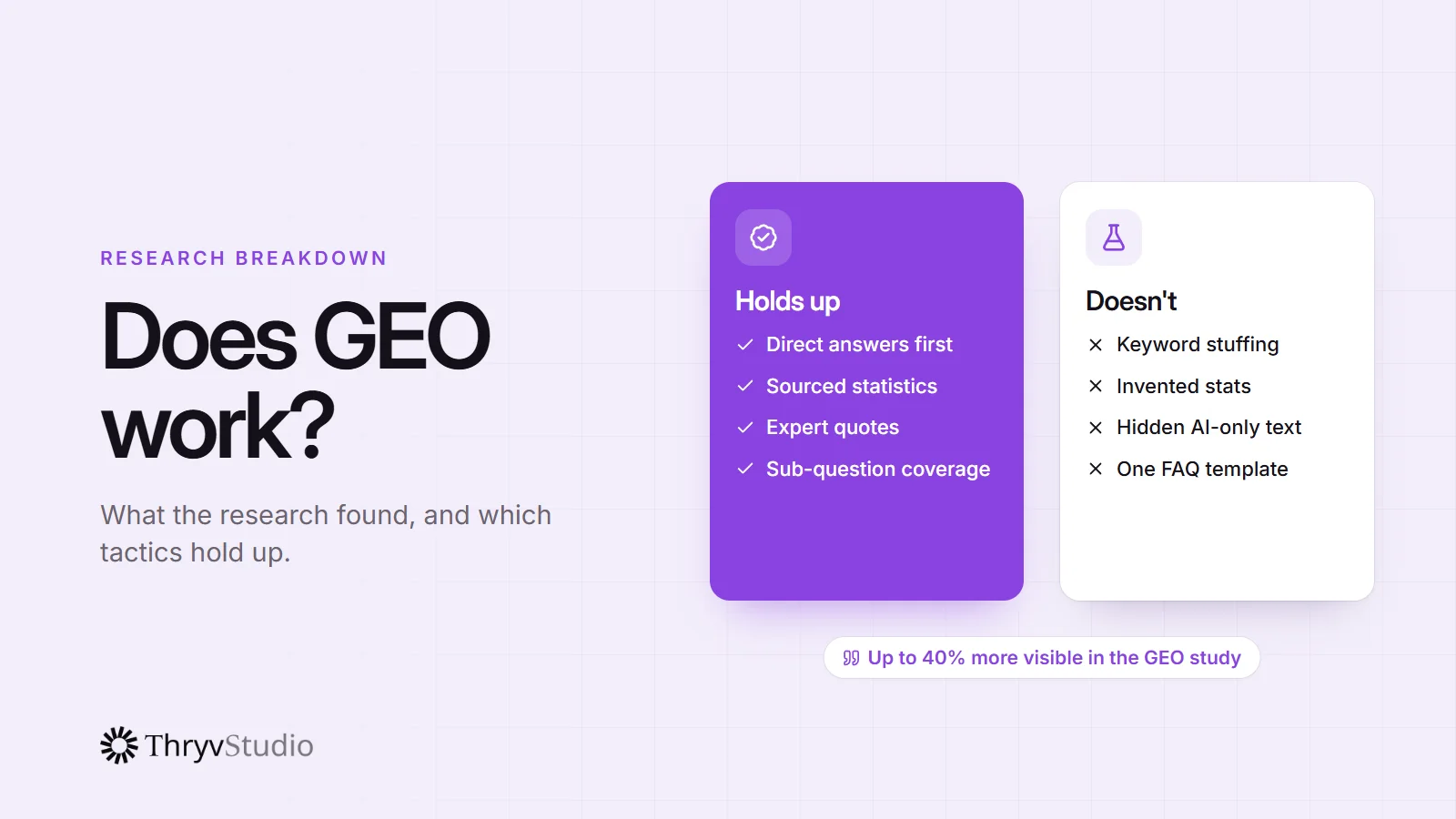
Partly. The research paper that named generative engine optimization (GEO) found that adding citations, quotations and statistics to a source made it up to 40% more visible in AI-generated answers, while keyword stuffing did not help. But that was a lab benchmark built in 2023 and 2024, and Google says no special optimization is needed for its AI features beyond helpful, accessible content. The GEO tactics that hold up are the ones that make content more specific, sourced and easy to quote. Tricks aimed at machines rather than readers don't. Test changes on your own pages before rolling them out.
Does generative engine optimization work?
Some of it does. The part of GEO that works is mostly good writing with evidence: clear answers, named sources, real numbers and quotable sentences. The part that doesn't work is anything that tries to game an AI system rather than inform a reader.
That distinction matters because "GEO" now covers both. Some agencies use it to mean careful, citable content. Others sell formatting templates, invented statistics and pages stuffed with question phrases. Searches for "generative engine optimization" have grown steadily over the past year, and so has the noise. This guide looks only at what the evidence supports.
Where GEO comes from: the original research
The term comes from a research paper, GEO: Generative Engine Optimization, by Pranjal Aggarwal and colleagues from IIT Delhi, Princeton and independent research. It was accepted at KDD 2024, a major data science conference.
The researchers built a benchmark called GEO-bench, a large set of queries across many subjects, each with web sources a generative engine could use. They rewrote sources using different methods and measured how visible each source became in the AI-generated answer. The paper reports that GEO "can boost visibility by up to 40% in generative engine responses", and up to 37% in tests on Perplexity, a real AI search engine.
Here's how the main methods performed, in plain terms:
| Method tested | What it means | Result in the study |
|---|---|---|
| Quotation addition | Add relevant quotes from credible sources | Among the strongest |
| Statistics addition | Replace vague claims with numbers | Among the strongest |
| Cite sources | Add citations to credible sources | Strong |
| Fluency optimization | Make the text read more smoothly | Strong |
| Easy-to-understand | Simplify the language | Moderate gain |
| Authoritative | Make the tone more persuasive | Moderate gain |
| Keyword stuffing | Repeat the query's keywords, old-SEO style | No gain; slightly worse than no change on some measures |
| Unique words | Add unusual vocabulary | Little or no gain |
The paper also found that "the efficacy of these strategies varies across domains". What works for history questions may not work for legal or health questions.
What the research doesn't prove
The study is useful, but it has limits that sales decks usually skip:
- It's a lab benchmark, not live search. Visibility was measured inside test answers built from a fixed set of sources, not in Google's live AI Overviews with billions of competing pages.
- The engines have changed. The research used systems available in 2023 and 2024. Google's AI Overviews now run on newer Gemini models, and AI Mode uses query fan-out to search many subtopics at once.
- It measured visibility in an answer, not business results. Being quoted more is not the same as more clicks, leads or sales.
- The best methods add real substance. Quotes, statistics and citations made sources more visible partly because they made sources more useful. That isn't a trick; it's better content.
What Google says about optimizing for AI features
Google's position has been consistent. Its May 2025 post, Top ways to ensure your content performs well in Google's AI experiences on Search, says the same guidance applies as for classic search. Focus on "unique, non-commodity content" that people find helpful. Make pages easy to use, make sure Google can access them, and keep structured data consistent with what's visible on the page.
Its guide to AI features and your website is blunter: "You don't need to create new machine readable files, AI text files, or markup to appear in these features. There's also no special schema.org structured data that you need to add."
Read together with the research, the message lines up. The tactics that help are the ones that make content more helpful and specific. There's no hidden switch.
What the live data suggests
Two recent findings add context.
First, Ahrefs found in March 2026 that only about 38% of pages cited in AI Overviews rank in the top 10 for the same search, and suggests query fan-out is why. That means coverage of sub-questions may matter more than formatting any single page.
Second, GEO-style content is spreading. A 2026 paper, GEO-Flag, built a detector for GEO-modified pages and ran it on real Google Search and Gemini results for 1,000 user queries. It estimated that 8.90% of pages showed GEO modification overall, rising to 16.36% among pages modified in 2026. The authors warn that GEO can give pages "visibility disproportionate to their authority or relevance". As more pages use the same tactics, the edge from tactics alone shrinks. And AI systems have every reason to discount content that looks engineered.
Which GEO tactics hold up
| Tactic | Verdict | Why |
|---|---|---|
| Answer the question in the first sentence or two of each section | Keep | Easy for people to scan and for AI systems to quote |
| Add real statistics with a named source | Keep | Supported by the research, and it makes claims checkable |
| Quote credible experts or primary documents | Keep | Strongest method in the study; adds authority |
| Link to primary sources inline | Keep | Helps readers verify; supports trust |
| Cover the sub-questions behind a topic | Keep | Matches how query fan-out builds answers |
| Show who wrote it and when it was updated | Keep | Helps readers and systems judge freshness and expertise |
| Invent or round up statistics to sound precise | Drop | Misleading, and AI answers can repeat the error under your name |
| Stuff headings with question variations | Drop | Keyword stuffing didn't help in the study and hurts readability |
| Add "AI-only" text, hidden prompts or special files for Google | Drop | Google says no special files or markup are needed; hidden text breaks its spam policies |
| Rewrite every page into the same FAQ template | Drop | Generic structure isn't the same as useful content |
How to test GEO changes on your own site
Don't take any study's average as a promise for your pages. Run a small test.
- Pick 10 to 20 similar pages. Same type, similar traffic, similar topics. For example, 16 service-area pages or 12 how-to guides.
- Split them into two groups. Change one group and leave the other alone as a control.
- Change one thing. For example, add a direct answer and a sourced statistic to the top of each section. Changing everything at once tells you nothing.
- Record a baseline. Note impressions and clicks in Search Console, AI impressions in the generative AI performance report, and whether each page is cited for its main questions in AI Overviews and assistants.
- Wait four to eight weeks. AI answers vary from day to day, so short tests mislead.
- Compare the groups, not just the before and after. If both groups moved the same way, the change wasn't the cause.
Keep a log of what you changed and when. Over a few rounds, you'll learn what actually works in your market.
GEO vs SEO: is GEO just SEO?
Mostly, yes, with a different focus. SEO aims to rank pages in a list of results. GEO aims to have your content used and cited inside an AI-generated answer. The foundations are the same: crawlable pages, helpful content, trust. GEO puts more weight on passage-level clarity, sourcing and covering related sub-questions. Our guide to AEO vs SEO vs GEO compares the three in detail.
Frequently asked questions
Does GEO really work?
The evidence supports some of it. The original GEO research found that adding quotes, statistics and citations made sources up to 40% more visible in AI answers in a lab benchmark. Tactics like keyword stuffing didn't help. Results vary by subject, and live search is more complex than the benchmark.
What is generative engine optimization?
Generative engine optimization (GEO) is the practice of making content more likely to be used and cited in AI-generated answers, such as Google's AI Overviews, ChatGPT and Perplexity.
What's the difference between GEO and SEO?
SEO aims to rank pages in search results. GEO aims to have content cited in AI answers. They share the same foundations, but GEO focuses more on clear, quotable passages, sources and covering related sub-questions.
Do I need special markup or files for GEO?
Not for Google. Google says you don't need new machine-readable files, AI text files or special structured data to appear in AI Overviews and AI Mode.
What GEO tactics should I avoid?
Avoid invented or exaggerated statistics, keyword stuffing, hidden text aimed at AI systems, and rewriting every page into the same template. They add risk without adding value for readers.
How long does GEO take to show results?
Expect weeks, not days. AI answers change often, so measure over four to eight weeks against a control group of pages you didn't change.