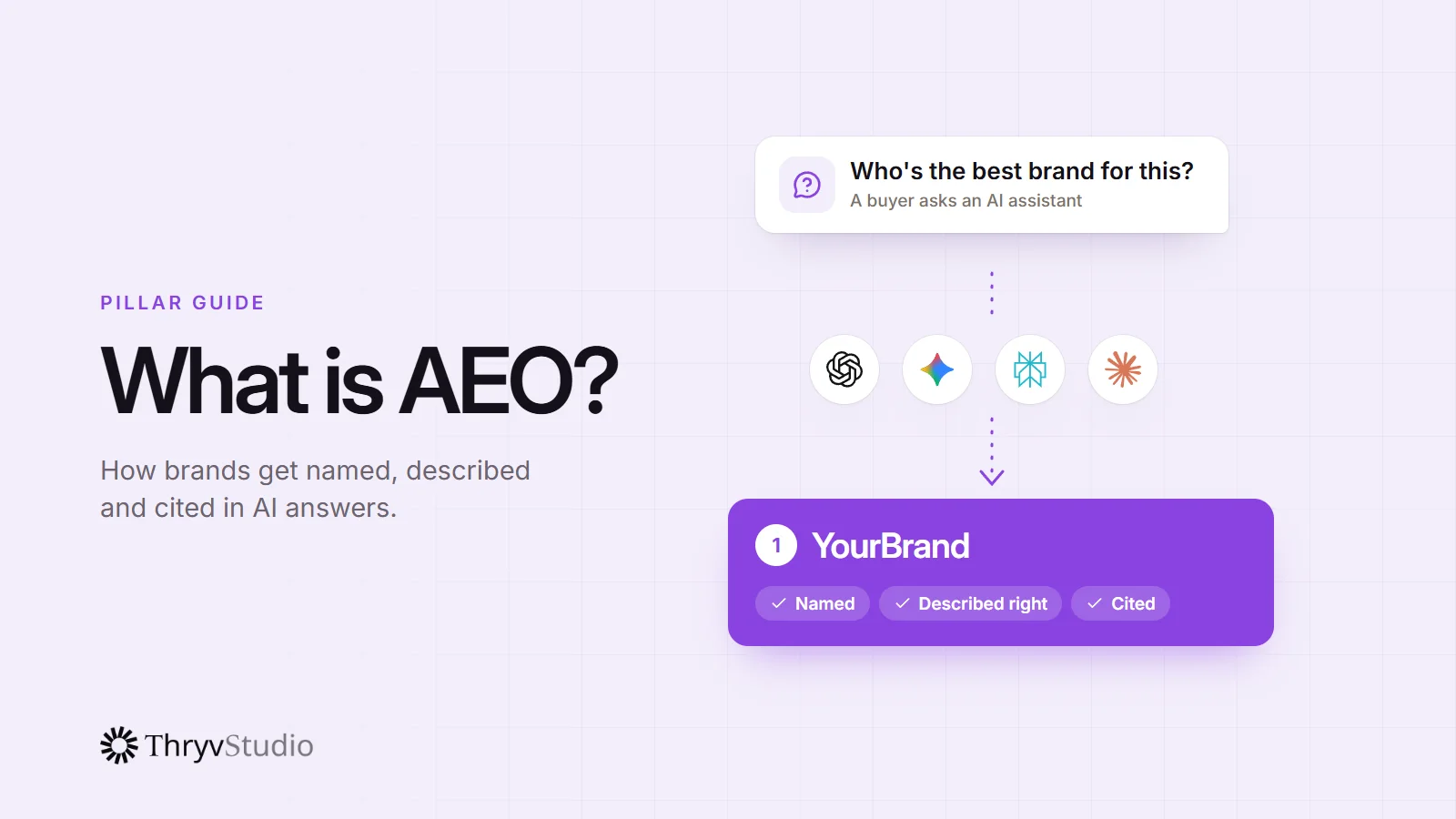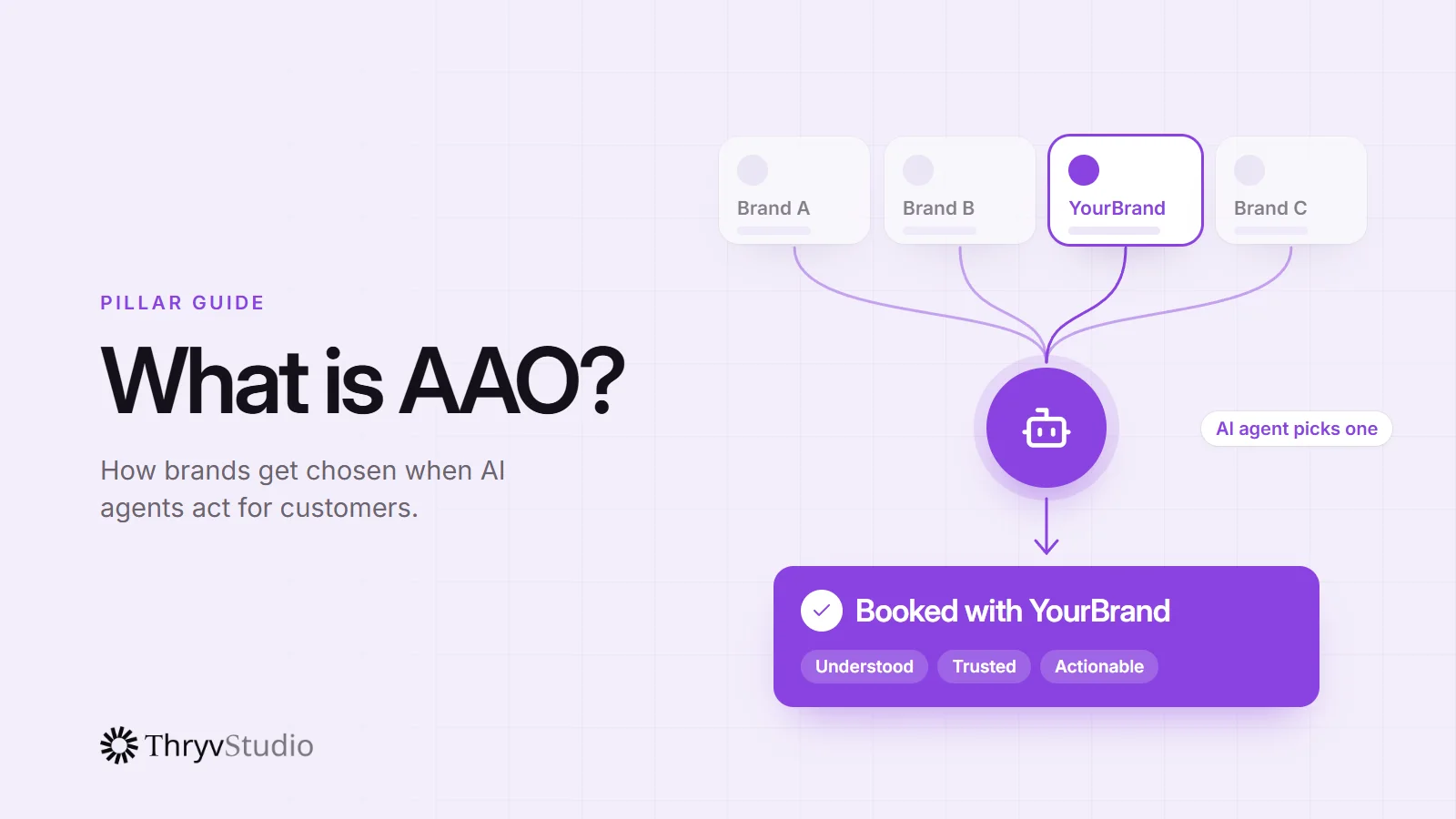
Assistive Agent Optimization (AAO) is the work of making a brand easy for AI agents to reach, understand, trust and act on, so the agent picks that brand when it completes a task for a customer, often with no person reviewing the options. Jason Barnard of Kalicube coined the term in 2025. AAO builds on SEO, AEO and GEO and adds one new test: can an agent actually finish the job with you?
What is AAO?
Assistive Agent Optimization (AAO) is the practice of preparing your brand so that AI assistants and agents can find you, understand you, trust you and complete tasks with you. The goal is to be the brand an agent picks when it acts on a customer's behalf, whether that means booking a demo, reserving a room or placing an order.
The term was coined in 2025 by Jason Barnard, founder of Kalicube, and set out in full in his February 2026 Search Engine Land article on AAO. Kalicube's own AAO methodology page describes it as an umbrella discipline that takes in SEO, Answer Engine Optimization, Generative Engine Optimization and the older acronyms around them. Barnard sums up the aim as being chosen "when no human is in the loop".
That phrase is the heart of the idea. Search engines show a list and let people choose. AI assistants narrow the list to a few recommendations. Agents go one step further: they make the choice and take the action. When an agent books a hotel for you, there is no page two.
You will occasionally see "AAO" expanded differently, as "AI agent optimization" or "agentic AI optimization". The meaning is close: optimizing for AI systems that act, not just answer. In this guide AAO means Assistive Agent Optimization, the term as Barnard defined it.
Why AAO matters now
AAO matters now because AI agents moved from demos into live products during 2025 and 2026. They can now check prices, compare options and, in some categories, complete purchases and bookings for the people who use them.
A short timeline of what changed:
- September 2025: OpenAI launched Instant Checkout in ChatGPT, built on the Agentic Commerce Protocol it developed with Stripe, so US users could buy some products without leaving the chat.
- November 2025: Google added agentic checkout to price tracking. When a tracked product drops to the shopper's target price, Google can buy it from eligible merchants with Google Pay, after the shopper confirms.
- January 2026: Google launched the Universal Commerce Protocol (UCP), an open standard for agentic shopping from discovery to post-purchase support, co-developed with Shopify, Etsy, Wayfair, Target and Walmart. It powers checkout on eligible listings in AI Mode and the Gemini app.
- February 2026: Chrome opened an early preview of WebMCP, a proposed web standard that lets a website declare actions, such as "search flights" or "submit this form", that browser agents can call directly instead of guessing from the screen.
- August 2026: Google began letting travelers in the US book hotels inside AI Mode, with the hotel or travel provider completing the booking.
Not every experiment stuck. In early 2026 OpenAI stepped back from Instant Checkout, saying the first version did not give the flexibility it wanted, and moved ChatGPT toward product discovery with checkout on the merchant's side. That correction is useful: agents are not yet buying most things for most people. But they are already deciding which brands make the shortlist, and in a growing number of narrow lanes, they finish the job.
AAO vs SEO, AEO and GEO
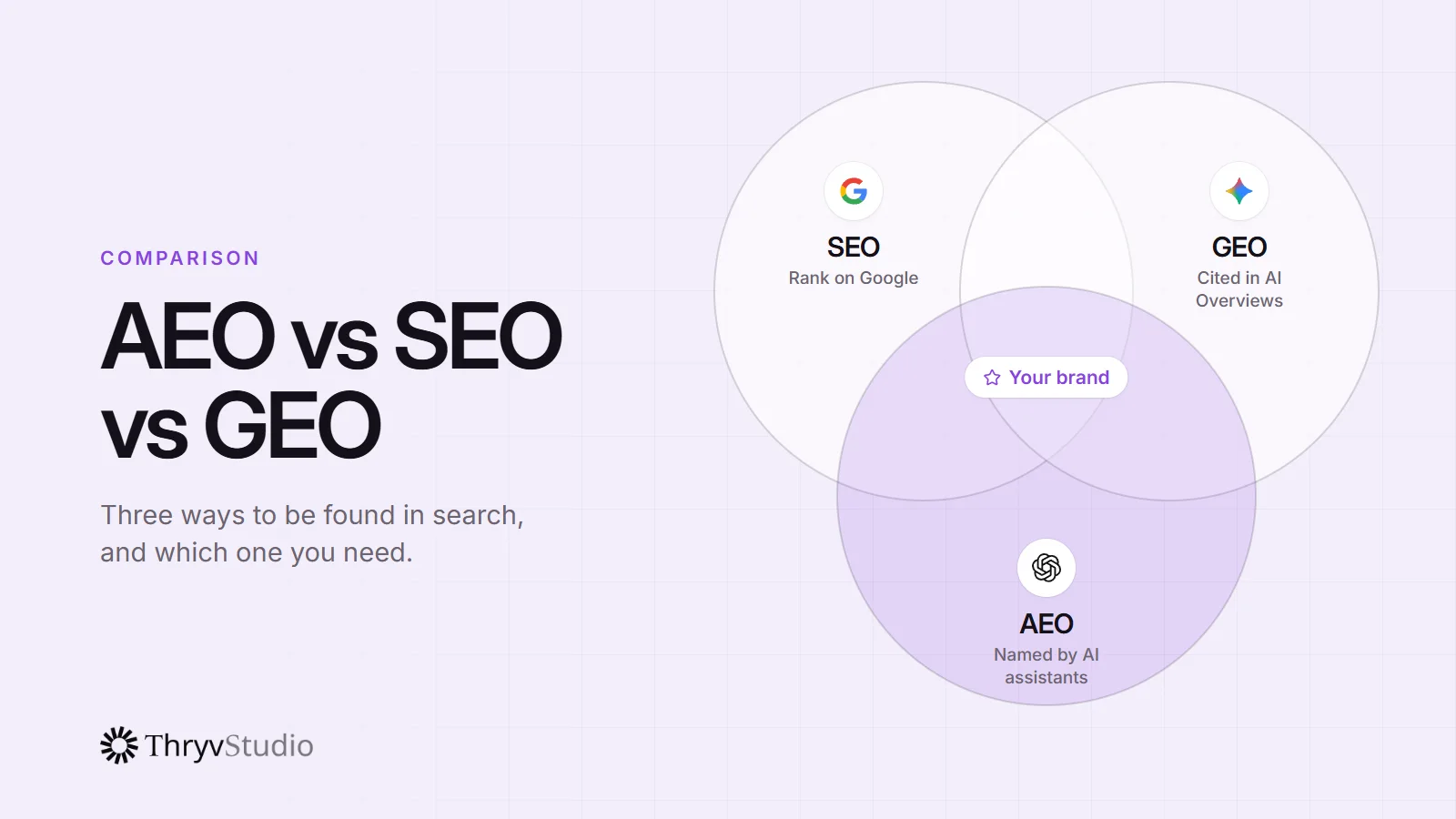
AAO does not replace SEO, AEO or GEO; it contains them. Each earlier discipline optimizes for one moment in the buyer's journey. AAO optimizes for the whole chain, ending with an agent that takes action.
| Discipline | What it targets | You win when | Is a person choosing? | Typical measure |
|---|---|---|---|---|
| SEO | Search engine results | Your page ranks for the search | Yes, from a list of links | Rankings, organic clicks |
| AEO | AI assistant answers | The assistant names and describes your brand | Yes, from a short answer | Share of answers |
| GEO | AI-generated search features, such as AI Overviews | Your page is cited as a source | Yes, after reading the summary | Citations, AI referral visits |
| AAO | AI assistants and the agents that act | The agent chooses you and completes the task | Often not | Selection rate, completed tasks |
The foundations are shared. Google states in its guidance on AI features and your website that AI Overviews and AI Mode have no special technical requirements: a page must be indexed and eligible to appear with a snippet, and the usual SEO best practices apply. Agents built on other systems behave much the same way. Most of AAO is therefore the work you already know, done more thoroughly, with one addition: the action at the end has to work. For a closer look at the first three, read our guide to AEO vs SEO vs GEO.
Three ways an AI agent can pick you
Barnard describes three outcomes for a brand in an AI-led journey. They are a useful planning tool because each one asks something different of you.
- The person decides. The assistant lists a few options, and the customer researches and chooses. To win, you need to be on the list and described accurately. This is how most AI shopping and service questions work today.
- The perfect click. The assistant recommends one option and the customer takes it. To win, you need to be the recommendation the assistant is most confident about. Everyone else loses the sale without ever knowing it was in play.
- The agent transacts. The agent acts under the customer's instructions and completes the task: it books, buys or schedules. To win, the agent must understand you, trust you, and be able to finish the job on your site or through your systems.
As you move down the list, the customer sees fewer options and the cost of being misunderstood rises. A vague description costs you a little in the first outcome. In the third, it costs you the sale, and nothing in your analytics will show the moment it happened.
How an AI agent chooses a brand: a walkthrough
Here is how an agent typically handles a realistic request. It is a composite of how today's assistants and browser agents work, not a recording of one product.
A customer types: "Find a project management tool under $15 per user that works with Slack, and book a demo for Tuesday."
- Read the task. The agent separates the constraints (category, price, integration) from the action (book a demo, on a date).
- Fan out. It runs several related searches at once, such as "project management tool Slack integration" and "project management pricing per user". Google documents this query fan-out approach for AI Mode.
- Build a shortlist. It gathers candidates from vendor pages, comparison articles, review sites and what it already knows about the category.
- Check the facts. It opens pricing pages, integration lists and review profiles. A vendor whose pricing says only "contact sales", or whose Slack integration is described in a gated PDF, becomes a risk the agent can avoid.
- Choose. It picks the option that meets the most constraints with the most confidence.
- Act. It opens the demo scheduler. If the form has unlabeled fields, hides inside a widget the agent cannot operate, or demands a phone call, the agent may come back with a competitor's Tuesday slot instead.
Every step is a place to lose. Notice that only steps 2 and 3 look like classic SEO. Steps 4 to 6 depend on facts, trust and a working path to action.
The four questions every agent asks
We organize AAO work around four questions an agent has to answer "yes" to before it chooses a brand. Barnard's own model goes further, mapping the journey from discovery and crawling through to the final choice in detail. The four questions are a practical way to run the work.
1. Can I reach you?
An agent cannot choose a site it cannot read. Check three layers, not one:
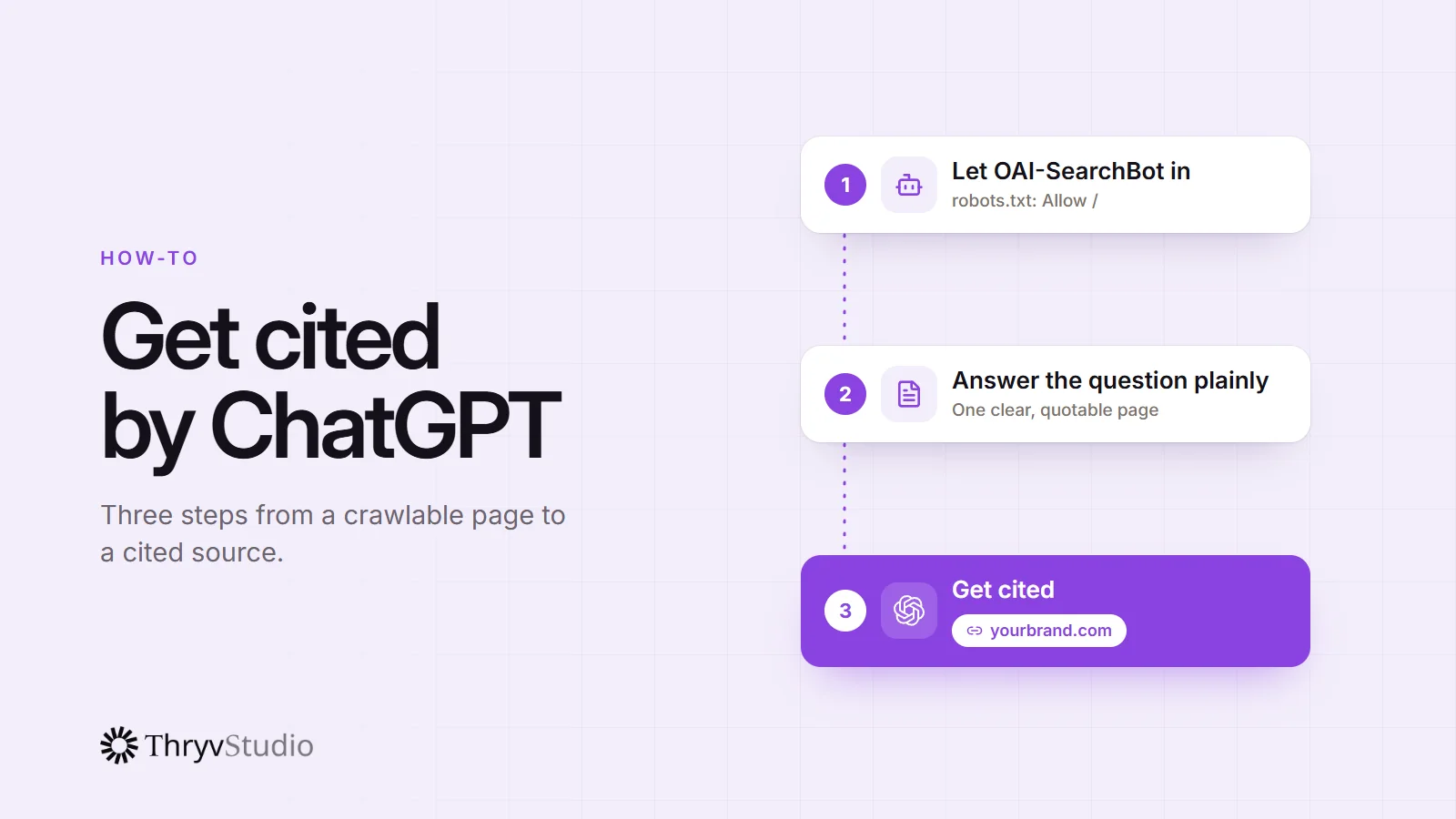
- robots.txt: decide which crawlers you allow, and confirm the rules say what you mean. Search crawlers, AI search crawlers and user-directed agents are different bots, and many brands block the ones they need by accident.
- Your server, CDN and firewall: these can refuse a bot that robots.txt welcomes, with an error or a block page that robots.txt will never show you. Test what your server actually answers each crawler, not just what your rules say; our free robots.txt checker shows the real response for each bot.
- Rendering: many AI crawlers read the HTML without running JavaScript. Prices, plans, contact details and key claims should be in the page source, not loaded by a script.
2. Can I understand you?
An agent will not choose a brand it cannot pin down. Make your identity and your offer unambiguous:
- Keep an entity home. One page you control, usually your home or About page, that says plainly who you are, what you sell, who it is for, where you operate and how to buy.
- Use category language. "Project management software for agencies" gives an agent something to match. "We help teams do their best work" does not.
- Keep facts identical everywhere. Name, category, prices, locations and contact details should match across your site, Google Business Profile, LinkedIn, marketplaces and review sites. Conflicting facts are the fastest route to being described wrongly, or skipped.
- Confirm it with structured data. Organization markup with links to your official profiles, plus Product, Service or LocalBusiness where they fit. Structured data should repeat what the page says, not replace it. Our guide to schema markup for AI search covers which types matter.
3. Can I trust you?
Being understood gets you considered. Trust gets you chosen. Agents weigh what others say about you more than what you say about yourself:
- Earn third-party corroboration. Reviews on the platforms your buyers use, coverage in publications your market reads, and honest comparison articles all count.
- Make your proof specific. A dated, named, checkable result can be quoted. "Amazing results" cannot.
- Publish what no one else has. Google's guidance on helpful, people-first content favors original information and first-hand experience, and they are the hardest things for competitors, or a model, to copy.
- Never fake it. Bought reviews and planted mentions break trust with people and break the rules of the platforms that rank you.
4. Can I act with you?
This is the question most advice skips, and it decides whether the agent finishes the job with you or with someone else:
- Publish offers machines can read. Price, availability, plans, delivery and returns belong on the page as text and, for retailers, in your product feeds, such as Google Merchant Center.
- Put your policies in plain text. Cancellation terms, return windows, delivery times and guarantees. Agents compare them, and a hidden policy looks like risk.
- Make forms and bookings work for software. Real buttons and links, labeled fields, no mandatory phone call to get a price, and a booking or checkout path that does not depend on a hover or a pop-up.
- Watch the new standards. Retailers can look at UCP-powered checkout on Google where it is available. Product teams can follow WebMCP, which lets a site declare its actions to browser agents. Both are new and changing, so treat them as experiments, not requirements.
- Keep a human handoff. A fast route to a person, such as chat or a phone number someone answers, saves the sale when an agent hits an edge case.
An AAO audit you can run this week
You can test most of the four questions in an afternoon. Here is the checklist we use as a starting point, with the free tool that runs each check.
| Check | How to test it | Free tool |
|---|---|---|
| AI crawlers can fetch your pages | Test robots.txt rules and the server's real answer for each bot | Robots.txt checker |
| Key facts are in the HTML | Look for prices, plans and contact details in the page source | AI search readiness checker |
| Your brand is defined in structured data | Check Organization, Product or Service markup for errors | Schema checker |
| Titles and descriptions say what the page is | Preview how search and AI tools will read each page | Meta tag checker |
| AI assistants describe you correctly | Ask several assistants who you are, what you sell and what it costs | AI visibility check |
| Links and booking paths work | Find broken links and dead ends on your key pages | Broken link checker |
| A short site map exists for language models | Generate or check an llms.txt file (optional) | llms.txt generator |
One caution on the last row: llms.txt is a proposal, not a standard, and Google does not require it for its AI features. It is cheap to add, but it will not fix problems in the rows above it. Our llms.txt guide explains what it can and cannot do.
The agent task test
The most revealing AAO check is also the simplest: give an AI agent a real task in your category and watch where it succeeds or fails. We call it the agent task test.
- Write five tasks your customers actually delegate. For example: "Book a demo with a project management tool under $15 per user that works with Slack." Include the constraints buyers really use.
- Run each task in two or three agents. Use the assistants and browser agents your customers are likely to use, with their default settings.
- Repeat each run several times. AI answers vary from run to run, so one attempt proves little.
- Log what happened at each step. Use a simple table:
| Task | Agent | Were you shortlisted? | Were you chosen? | Where did it stall? | Fix |
|---|---|---|---|---|---|
| Book a demo, under $15, Slack | Assistant A | Yes | No | Pricing page said "contact sales" | Publish per-user prices |
| Book a demo, under $15, Slack | Assistant B | No | No | Not found for "Slack integration" | Add an integrations page |
Patterns appear quickly. If you are never shortlisted, work on the first two questions. If you are shortlisted but rarely chosen, work on trust. If you are chosen but the task fails, work on action. The test turns an abstract discipline into a list of specific fixes.
How to measure AAO
Rankings cannot measure AAO, because there is often no list to rank in. Track these instead:
- Share of answers. Across a fixed set of buyer questions, how often do assistants name you? Measure it over many runs. A SparkToro study with Gumshoe ran 2,961 prompts through ChatGPT, Claude and Google's AI features and found less than a 1 in 100 chance that ChatGPT or Google's AI would return the same list of brands twice. Lists change constantly, so a share across many runs is meaningful and a single "position" is not.
- Description accuracy. When assistants describe you, are the category, prices and key facts right?
- Selection rate. In your agent task tests, how often are you chosen?
- Task completion. When an agent chooses you, how often does the booking, order or form actually go through?
- AI referral traffic and conversions. Visits and leads arriving from assistants, tracked in your analytics.
Our guide to measuring AI visibility explains how to build the question set, run the checks and track AI referral traffic in Google Analytics 4.
Who needs AAO first?
Every brand needs the foundations, but urgency depends on how much your customers already hand over to agents. Kalicube calls this the "delegation boundary": the point up to which a customer is willing to let an agent decide.
| Type of purchase | How much agents act today | Why |
|---|---|---|
| Repeat, low-risk purchases (refills, household items) | High and rising | Known product, known price, little regret if slightly wrong |
| Products compared on specs and price (electronics, hotel rooms) | Rising | Agents compare facts, reviews and prices well |
| Local services and bookings (appointments, restaurants) | Early but moving | Agents can check availability and book |
| Big, considered decisions (B2B services, finance, healthcare) | Low for now | Large sums, regulation and relationships keep people in charge |
Even at the bottom of the table, AAO still matters. In considered purchases the first outcome, the person decides, dominates, and that person increasingly builds a shortlist by asking an assistant. Being understood and trusted by that assistant is how you get on the list.
Common AAO mistakes
- Treating AAO as a rename of SEO. SEO is part of it. AAO adds trust built off your site and the ability to complete a task.
- Looking for special AAO markup. There is no AAO tag. Structured data helps when it confirms what the page already says.
- Blocking the bots you need. Firewalls and bot protection often block AI crawlers by default. Decide your crawler policy on purpose, then test it.
- Hiding the facts agents need. "Contact us for pricing", policies in PDFs and key details behind a login all push agents toward competitors who show them.
- Relying on JavaScript for core content. If a script has to run before your price appears, many AI crawlers will never see it.
- Chasing one assistant. Customers use several. Fix the foundations and every assistant benefits.
Frequently asked questions
What does AAO stand for?
AAO stands for Assistive Agent Optimization: the practice of making a brand easy for AI assistants and agents to understand, trust and act on, so they choose it when they complete tasks for people. The acronym is sometimes expanded as "AI agent optimization", with a similar meaning.
Who coined the term Assistive Agent Optimization?
Jason Barnard, founder of Kalicube, coined the term in 2025 and set it out in detail in a February 2026 article in Search Engine Land. He describes it as the umbrella over SEO, AEO and GEO.
How is AAO different from GEO?
GEO aims to get your pages cited as sources in AI-generated answers, such as Google's AI Overviews. AAO includes that, but its end point is an agent choosing your brand and completing a task, such as a booking or a purchase, often without a person reviewing the options.
Does AAO replace SEO?
No. Search engines and AI systems still have to find and index your pages, and Google says its AI features rely on the same ranking and quality systems as Search. AAO builds on SEO and adds trust and actionability on top.
Can AI agents really buy without a person?
In some lanes, yes. Google's agentic checkout buys from eligible merchants after the shopper confirms, UCP powers checkout inside AI Mode and the Gemini app, and US travelers can book hotels inside AI Mode. Most purchases still involve a person at some point, but agents increasingly decide which brands that person sees.
How do I start with AAO?
Start with the four questions. Check that AI crawlers can reach your site, make your brand and prices unambiguous on your own pages, build third-party proof, and make sure a form or booking can be completed by software. Then run the agent task test to find your biggest gap.