Agentic commerce is shopping where AI agents do part of the work for people, from comparing products to completing checkout. Google's Universal Commerce Protocol (UCP), launched in January 2026, is an open standard for it. Google says UCP already enables direct checkout for hundreds of thousands of brands and retailers, and its Universal Cart launched in the US in October 2026. To be chosen by shopping agents, a store needs complete, accurate product data, clear prices and policies, trustworthy reviews and a checkout that software can complete.
What is agentic commerce?
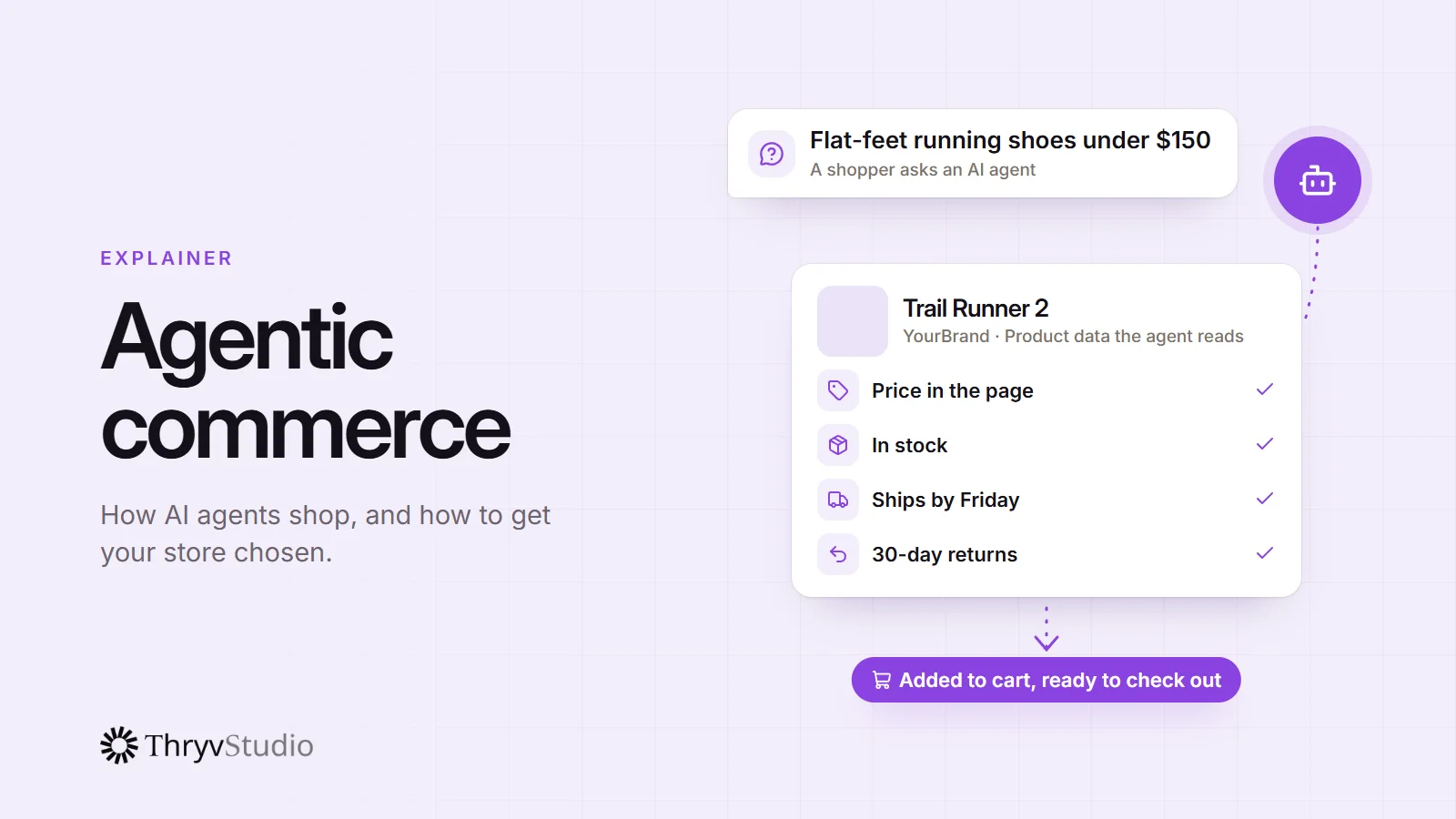
Agentic commerce is shopping where an AI agent does some or all of the work on a person's behalf. Instead of opening ten tabs, a shopper tells an assistant what they want, such as "running shoes for flat feet under $150, delivered by Friday". The agent compares options, tracks prices and, increasingly, completes the purchase.
It differs from ordinary ecommerce in one important way: the first "visitor" to your store may be software, not a person. The agent reads your product data, prices, stock and policies, decides whether you fit, and in some cases checks out. If it can't understand you, it moves on to a store it can understand.
Search for the term has grown fast. In SE Ranking's US data, "agentic commerce" went from a few hundred searches a month in late 2025 to about 4,400 a month in October 2026.
How we got here: a timeline
| Date | What happened |
|---|---|
| September 2025 | OpenAI launched Instant Checkout in ChatGPT, built on the Agentic Commerce Protocol it developed with Stripe |
| November 2025 | Google added agentic checkout to price tracking: when a tracked product hits the shopper's price, Google can buy it from eligible merchants after the shopper confirms |
| January 11, 2026 | Google launched the Universal Commerce Protocol (UCP), an open standard for agentic shopping, co-developed with Shopify, Etsy, Wayfair, Target and Walmart |
| Early 2026 | OpenAI stepped back from Instant Checkout, moving ChatGPT towards product discovery with checkout on the merchant's side |
| September 16, 2026 | Google said UCP already enables direct checkout for hundreds of thousands of brands and retailers, and added cart transfer to the UCP hub in Merchant Center |
| October 15, 2026 | Google's Universal Cart launched in the US across Search and the Gemini app |
The OpenAI correction is worth noting. Not every experiment sticks, and agents aren't buying most things for most people yet. But the infrastructure is being built quickly, and agents already shape which stores make a shopper's shortlist.
What is the Universal Commerce Protocol (UCP)?
The Universal Commerce Protocol is an open standard that lets AI agents and stores talk to each other in a common language, from discovering products to checkout and after-sales support. Google announced it at the National Retail Federation conference in January 2026, co-developed with Shopify, Etsy, Wayfair, Target and Walmart.
Think of it as the plumbing. Without a shared standard, every agent would need a custom integration with every store. With UCP, a store that supports the protocol can be understood and transacted with by any agent that speaks it.
For merchants, Google runs UCP through Merchant Center. In September 2026, Google said merchants using the UCP integration hub there can enable features such as cart transfer to their own site and better checkout testing, with these capabilities rolling out in the US first and Australia and Canada to follow early in 2027.
What is Google's Universal Cart?
Universal Cart is a shopping cart that works across stores. According to Google's October 2026 launch post, shoppers can:
- save products from different retailers in one place
- get alerts about price drops and items coming back in stock
- see suggested payment methods and relevant promo codes
- check out with Google Pay, or move items to the merchant's own site to finish the order
It's available in the US across Google Search and the Gemini app. For stores, it means a product can be found, saved and bought without the shopper ever browsing your category pages.
What changes for your store
Agentic commerce shifts the work from persuading people page by page to being legible to software and trusted by it.
| Before agents | With agents |
|---|---|
| Shoppers browse category pages and filters | Agents read product data and compare across stores in seconds |
| Persuasive copy and photos win the click | Accurate attributes, prices and stock win the shortlist |
| Policies sit in a footer few people read | Agents check shipping, returns and delivery dates before choosing |
| Reviews persuade at the final step | Reviews and reputation filter you in or out early |
| Checkout is designed for humans | Checkout must also work through protocols and agents |
Google also made AI performance insights in Merchant Center generally available in September 2026, in Australia, Canada, India, New Zealand and the US. It shows how a brand's products are being discovered by comparing share of voice with other brands across AI Mode and AI Overviews. That's a sign of where measurement is heading: visibility in AI answers, not just clicks.
How to get your store ready for AI shopping agents
1. Make your product data complete and accurate
Your product feed is now your shop window. Fill in every relevant attribute: size, colour, material, compatibility, dimensions, use case. Keep titles descriptive rather than clever. Make sure prices and stock levels update quickly; an agent that finds a wrong price or an out-of-stock item will lose trust in your data.
2. Mark up product pages with structured data
Use Product and Offer structured data on product pages, including price, availability, shipping details and return policy where they apply. Make sure the markup matches what's visible on the page, because Google's guidelines require it. Our schema checker finds errors, and the schema markup generator builds valid markup. For the bigger picture, read our guide to schema markup for AI search.
3. State policies plainly, in text
Shipping costs, delivery times, return windows and warranty terms should be in plain HTML on your site, not only in PDFs or images. Agents compare these, and vague policies push them towards competitors who are clear.
4. Build reviews and reputation
Agents and the assistants behind them weigh reviews, ratings and what the web says about you. Ask customers for reviews on your site and on the platforms that matter in your category, and answer them. Our guide on brand mentions vs backlinks explains why third-party mentions matter so much for AI visibility.
5. Join the programs agents use
If you sell on Google, keep your Merchant Center account in good standing and look at the UCP integration hub. If your platform, such as Shopify, supports agentic checkout or UCP, check what's needed to switch it on. Being eligible is the first step to being chosen.
6. Make sure agents can reach your site
AI crawlers and agents need to fetch your pages. Check that your robots.txt, firewall and bot protection don't block the crawlers you want, and that key product facts aren't hidden behind scripts. Our AI search readiness checker tests this.
An agent-ready store checklist
| Check | How to test | Free tool |
|---|---|---|
| Product pages have valid Product and Offer markup | Run key product URLs through a validator | Schema checker |
| Prices, stock and shipping are in the HTML | View page source and search for the price | AI search readiness checker |
| AI crawlers aren't blocked | Test robots.txt rules for each bot | Robots.txt checker |
| Return and shipping policies are clear and linked | Read them as a stranger would | Manual check |
| Reviews are visible and recent | Check your site and the main review platforms | Manual check |
| An AI assistant describes your products correctly | Ask several assistants about your top products | AI visibility check |
Who should act first?
Agents move fastest where products are easy to compare and purchases are low-risk: repeat buys, electronics, household goods, fashion basics and travel. If you sell in those categories, start now. If you sell high-value or highly personal products, agents will mostly shape the shortlist for now, while people still make the final decision. The foundations above still apply.
For the wider picture of how agents choose brands, beyond shopping, read our guide to Assistive Agent Optimization.
Frequently asked questions
What is agentic commerce?
Agentic commerce is shopping where AI agents act for people: finding products, comparing options, tracking prices and, in some cases, completing the purchase.
What is the Universal Commerce Protocol?
The Universal Commerce Protocol (UCP) is an open standard that Google launched in January 2026 with Shopify, Etsy, Wayfair, Target and Walmart. It lets AI agents and stores work together across the shopping journey, including checkout.
Can AI agents really buy products for people?
In some cases, yes. Google says UCP already enables direct checkout for hundreds of thousands of brands and retailers, and Google's agentic checkout can buy a tracked product for a shopper after they confirm. Most purchases still involve a person approving the final step.
What is the difference between UCP and the Agentic Commerce Protocol?
They're separate standards. UCP was launched by Google with major retailers and platforms. The Agentic Commerce Protocol was developed by OpenAI with Stripe for checkout in ChatGPT. Both aim to let AI agents complete purchases with merchants.
How do I prepare my online store for AI shopping agents?
Keep product data complete and accurate, add Product and Offer structured data, state shipping and return policies plainly, build reviews, join the programs agents use (such as Merchant Center and UCP), and make sure AI crawlers can reach your pages.
Is agentic commerce only for big retailers?
No. Google says UCP checkout already covers hundreds of thousands of brands and retailers, and platforms like Shopify helped build it. Small stores that keep clean data and clear policies can compete with larger ones.